

Unnatural links are one of the biggest threats to a website’s search engine visibility. If your backlink profile looks manipulative or spammy, Google can take action by lowering your rankings or even removing your site from search results. This is called an Unnatural Links Penalty. For businesses, bloggers, and SEO professionals, understanding how these penalties work and how to avoid or recover from them is essential.
Search engines reward natural, high-quality links that show real trust and relevance. But shortcuts like buying links, using private blog networks, or spamming comments can backfire fast.
An Unnatural Links Penalty occurs when Google detects backlinks pointing to your site that violate its Webmaster Guidelines. These links are considered manipulative because they are not earned naturally, but created with the intent to artificially boost rankings.
Think of backlinks as votes of trust. When other sites link to you, Google assumes your content is valuable. But if those “votes” are fake or bought, it undermines the credibility of the search system. That’s why Google penalizes websites with suspicious backlink profiles.
Penalties can lead to:
Google’s official guidance on link schemes clearly states that any attempt to manipulate links can result in penalties.

Google’s mission is to deliver the most relevant and trustworthy search results. If websites could simply buy or create fake links to rank, search results would be full of low-quality sites.
By penalizing unnatural links, Google:
According to a 2024 SEMrush study, over 45% of manual actions issued by Google are related to unnatural links, making it one of the most common penalties today.
Understanding the different penalty types helps you diagnose problems faster and choose the right recovery strategy. Not all penalties are created equal, and the approach that works for one type might be completely wrong for another.
These are the most severe penalties, affecting your entire website across all keywords and pages. Site-wide actions typically indicate extensive or long-term link manipulation that Google considers particularly egregious.
Common triggers for site-wide penalties:
Recovery from site-wide penalties requires a comprehensive cleanup and can take 6+ months even with perfect execution.
Partial actions target specific pages or link types while leaving the rest of your site unaffected. These are more common and often easier to recover from because the scope is limited.
Examples of partial penalties:
The targeted nature of partial penalties often makes them faster to identify and fix.
Google’s Penguin algorithm runs continuously, evaluating link profiles in real-time. Unlike manual actions, algorithmic penalties don’t come with notifications – you have to detect them through traffic and ranking analysis.
Penguin focuses on:
Modern Penguin is more surgical than previous versions, often penalizing specific pages or keywords rather than entire sites.
While Google claims they’re good at identifying when bad links aren’t your fault, negative SEO penalties do happen. Competitors or malicious actors can sometimes trigger penalties by building obvious spam links to your site.
The good news is that effective negative SEO requires significant resources and expertise. Most competitors can’t pull off campaigns sophisticated enough to cause real damage.
Signs of negative SEO attacks:
Recognizing penalty symptoms early is important for minimizing damage and starting recovery quickly. Some penalties are obvious, while others can be subtle and easy to miss without proper monitoring.

This should be your first stop when investigating potential penalties. Google Search Console provides direct notifications for manual actions.
Navigation path: Security & Manual Actions → Manual Actions
Common penalty messages:
If you see any manual actions listed, you have confirmed penalties that require formal reconsideration requests to remove.

Sudden and significant drops in website traffic often signal algorithmic penalties, particularly when they align with known Google updates. Common indicators include a 50% or greater decline in traffic within one to two weeks, widespread ranking losses across multiple keyword groups, drops that coincide with link-related updates like Penguin, and decreases that disproportionately affect commercial keywords.
To diagnose these issues effectively, use Google Analytics to monitor organic traffic trends and distinguish between abrupt changes and gradual declines.
Monitoring keyword positions is essential for spotting penalty-specific patterns that can help differentiate between algorithm updates and actual penalties. Warning signs include commercial keywords declining while informational ones stay stable, significant drops in rankings for keywords with aggressive anchor text profiles, multiple keywords simultaneously falling from page one to page three or beyond, and position losses that don’t align with increased competition.
Tools like SEMrush, Ahrefs, and AccuRanker offer granular ranking data that makes it easier to detect these anomalies and respond strategically.
Even if your site hasn’t experienced a noticeable traffic drop, examining your backlink profile can reveal patterns that may have triggered or could soon trigger algorithmic penalties. Key warning signs include a high volume of links from clearly low-quality domains, anchor text distributions dominated by commercial terms, recent link acquisitions from networks known to be penalized, and sudden spikes in link velocity without a credible source.
Conducting regular backlink audits is essential for spotting these risks early and maintaining a clean, penalty-resistant link profile.

Before making any changes, it’s essential to document your penalty and current SEO status in detail, as this record will be critical for submitting reconsideration requests and tracking recovery progress. Key items to include are screenshots of manual action messages from Google Search Console, organic traffic data before and after the penalty, ranking positions for your most valuable keywords, a complete backlink profile export from multiple tools, and a timeline noting when issues first appeared.
Organize everything in a penalty recovery folder by date—this will serve as a reference throughout the recovery process and in any communications with Google. Thorough documentation also helps prevent repeating the mistakes that led to the penalty.
Get a comprehensive view of all links pointing to your website using multiple tools, since no single tool captures every backlink.
Recommended tools for complete backlink data:
Export data from each tool and combine them into a master spreadsheet. Remove duplicates and focus on links that appear in multiple tools, as these are more likely to be real and impactful.
Sort your links by various criteria like linking domain authority, anchor text, link placement, and link acquisition date. This helps you identify patterns and prioritize which links to address first.
Divide all your backlinks into categories based on their quality and potential to cause penalties. This helps you prioritize your cleanup efforts and make strategic decisions about which links to keep or remove.
High-quality backlinks are those you should preserve, as they contribute positively to your site’s authority and trustworthiness. These include editorial links from respected industry websites, backlinks from government, educational, or major media domains, and those earned through authentic content marketing or public relations efforts. Also valuable are links from professional associations or business partners, especially when they feature natural, contextually relevant anchor text that aligns with your content.
Medium-quality backlinks fall into a gray area and should be evaluated individually to determine their current value and risk. These may include links from directories that maintain editorial standards, guest posts published on legitimate and contextually relevant websites, and backlinks from smaller domains that cater to real audiences. Additionally, older links that were acceptable when originally built might now require reassessment based on evolving SEO guidelines and best practices.
Low-quality backlinks are often the root cause of search engine penalties and should be removed or disavowed to protect your site’s credibility. These typically include links from blatant link networks or private blog networks (PBNs), paid placements on sites that openly sell backlinks, and entries in spam directories or link farms.
Also problematic are links featuring over-optimized anchor text designed to manipulate rankings, as well as backlinks from unrelated or visibly low-quality websites that offer no real contextual relevance or authority. Addressing these links is a key step in any penalty recovery strategy.
Toxic backlinks pose a serious threat to your site’s search visibility and reputation, and should be removed or disavowed without hesitation. These include links from penalized or deindexed domains, as well as those originating from adult, gambling, or pharmacy websites—unless your content is directly relevant to those industries.
Also harmful are spammy backlinks generated through forums, comment sections, or automated link-building tools, along with any links from hacked or malware-infected sources. Eliminating these toxic connections is a key step in restoring trust with search engines and safeguarding your site’s long-term performance.
Before turning to Google’s disavow tool, make a genuine effort to remove harmful backlinks through direct outreach to the site owners—Google favors this proactive approach and may respond more positively to reconsideration requests that show you’ve tried. Start by identifying contact information for websites hosting problematic links, then send courteous emails requesting removal.
If you don’t hear back, follow up once after a week or two. Throughout the process, document every outreach attempt and response, and track which links are successfully removed. Maintain a detailed log of dates, communications, and outcomes—this record will be vital when compiling your disavow file and submitting any formal reconsideration requests.
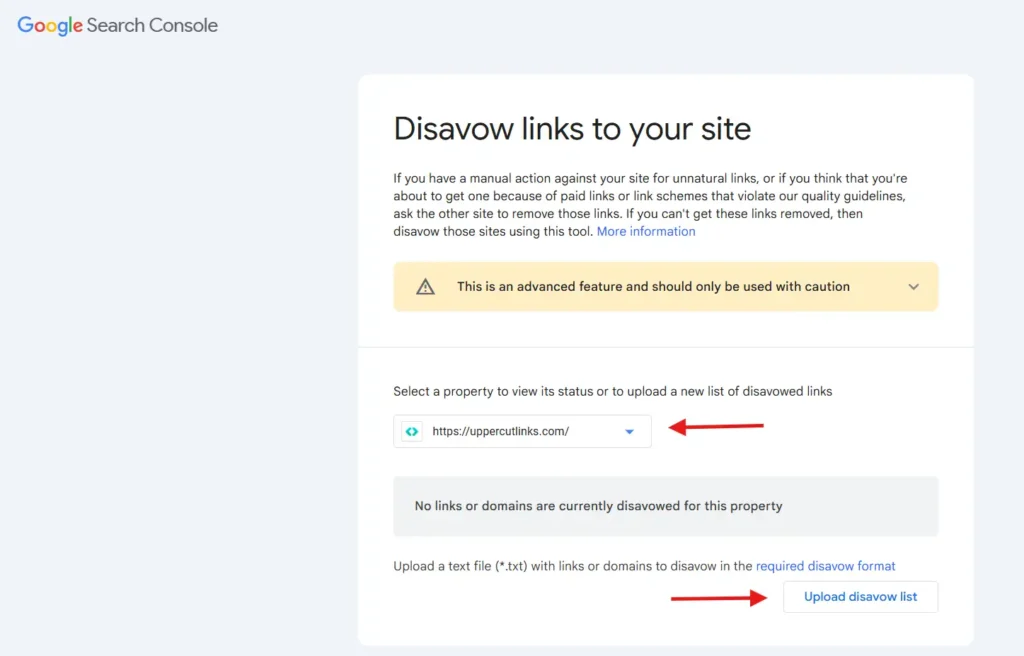
For links you cannot remove manually, use Google’s disavow tool to tell it to ignore these links when evaluating your website.
Disavow file format: The disavow file is a simple text file with one URL or domain per line. You can disavow specific pages or entire domains.
Example disavow file:

Disavow file best practices:
Upload your disavow file through Google Search Console in the “Disavow Links” tool. The file can take several weeks or months to take effect, so be patient with the process.
If you have a manual action penalty, you must submit a reconsideration request asking Google to review your cleanup efforts and lift the penalty.
Elements of a strong reconsideration request:
Submit your request through Google Search Console and wait for Google’s response. This can take anywhere from 2 weeks to several months, depending on the complexity of your case and Google’s current review backlog.
Recovery from unnatural link penalties takes time—often three to six months or more—depending on the severity of the issue and the thoroughness of your cleanup. During this period, monitor manual action updates in Google Search Console, organic traffic trends in Google Analytics, keyword ranking shifts, and the quality of new backlinks. Keep an eye on competitor activity and conduct regular backlink audits to catch harmful links early.
Stay alert for negative SEO attacks, maintain strict quality control over new link-building efforts, and document everything. Patience, persistence, and consistent monitoring are key to restoring your site’s search visibility.
Prevention is always better than recovery when it comes to Google penalties. By following best practices and staying away from risky tactics, you can protect your website from future penalties while still building a strong link profile.
The most sustainable way to earn backlinks is by creating genuinely valuable content that others naturally want to reference. While this method takes more time than artificial link building, it’s far more resistant to penalties. Effective strategies include publishing original research, comprehensive guides, interactive tools, and newsworthy articles. Guest posting on reputable sites also helps.
Content that attracts organic links includes industry reports, tutorials, free tools, opinion pieces, and visual assets like infographics. The key is usefulness—when your content solves real problems or offers unique insights, people will link to it without needing outreach or manipulation. Quality earns trust, and trust earns links.
Keep your anchor text distribution looking natural by avoiding over-optimization with exact-match commercial keywords.
Healthy anchor text distribution:
Red flag anchor text patterns to avoid:
When you do guest posting or other outreach, ask for natural anchor text that fits the context of their content rather than demanding specific keyword phrases.
Building links from a diverse range of high-quality sources helps create a natural-looking link profile and minimizes risk if any single source becomes problematic. Ideal diversity includes industry publications, local directories, government and educational sites, news outlets, professional associations, customer and partner websites, and social platforms. Avoid relying too heavily on one type of site, a small group of domains, a single outreach method, or links from one geographic or technological cluster.
A well-balanced mix—across geography, topic, and tech—signals authenticity to search engines and reduces the likelihood of triggering penalties, making your SEO strategy more resilient and future-proof.
To maintain a healthy backlink profile and avoid penalties, it’s essential to set up a continuous monitoring system. Implement a monthly routine that includes checking Google Search Console for new manual action messages, reviewing new backlinks acquired in the past 30 days for suspicious patterns, monitoring anchor text distribution to prevent over-optimization, and staying vigilant for potential negative SEO attacks. By regularly auditing your backlinks, you can catch problems early and address them before they harm your website’s rankings.
Here are the tools for ongoing monitoring:
Set up alerts to notify you when you gain or lose significant numbers of backlinks, so you can investigate quickly if something suspicious happens.
Early detection of problems makes recovery much easier than waiting until after you’ve been penalized.

Google’s link-building guidelines evolve, so staying informed about updates helps you avoid newly prohibited tactics.
Key resources to follow:
To stay ahead in link building, it’s crucial to be aware of recent guideline changes. Here are the key updates:
Make sure anyone working on your link building (employees, contractors, or agencies) stays updated on current guidelines and follows them strictly.
When working with external partners for link building, ensure they strictly follow white-hat practices to protect your site from penalties. Ask for examples of past work, their quality standards, how they comply with Google’s guidelines, and what recourse they offer if their tactics lead to penalties.
References from long-term clients can also reveal reliability. Watch out for red flags like guaranteed rankings, unusually low prices, vague methods, quantity-over-quality promises, and no mention of compliance risks.
Always get their approach, standards, and guarantees in writing before committing—transparency and accountability are essential for safe, sustainable link-building partnerships.
The time to recover varies greatly. Identifying and cleaning up all bad links can take weeks or even months of diligent effort. After submitting a reconsideration request, Google’s review process can take several days to a few weeks. Once lifted, it may still take additional weeks or months for your rankings and traffic to fully rebound as Google re-evaluates your site.
An unnatural links penalty can affect your entire website (a “sitewide” penalty) or just specific sections or pages, depending on the scope and nature of the unnatural links detected. The notification in Google Search Console will usually specify the scope.
While Google’s algorithms are generally good at recognizing and disregarding malicious negative SEO attacks, in rare cases, a manual penalty could theoretically occur if a very aggressive, sustained attack goes undetected by algorithms. In such cases, it’s vital to disavow the harmful links proactively to signal to Google that you do not endorse them.
While not strictly necessary to lift the penalty, it’s always a good practice to ensure your sitemap is up-to-date and submitted to Google Search Console. This helps Google efficiently crawl and index your website’s legitimate pages after the penalty is removed, aiding in the recovery process.
The journey to understanding unnatural links penalties reveals a fundamental SEO truth: shortcuts rarely lead to sustainable success. Google’s dedication to providing the best search experience means manipulative tactics are detected and penalized. By committing to valuable content, earning natural backlinks ethically, and monitoring your backlink profile, you build a strong, trusted foundation that Google rewards.
Focus on quality, transparency, and your website achieves lasting success, outweighing short-term gains with long-term benefits.