

Let’s be honest. In the ever-shifting world of SEO, the term “Web 2.0 backlinks” can feel like a relic from a bygone era. You’ve heard the whispers that they’re outdated, spammy, or even dangerous. Some gurus dismiss them entirely, while others whisper they are a secret weapon for dominating the SERPs.
So, what’s the truth in 2026?
The truth is: Web 2.0 backlinks are more potent than ever, but the rules of the game have completely changed.
Gone are the days of spinning an article and blasting it to 50 generic blogs. Today’s Google algorithm is smarter, and it rewards authority and quality. A low-effort, spammy approach won’t just fail; it can actively harm your website.
But a strategic, quality-focused approach? That’s where you gain an unfair advantage.
This is not just another recycled list of websites. This is a complete blueprint for building a powerful network of Web 2.0 properties that act as genuine, authority-building assets for your brand.
In this guide, you will get:
Prepare to change the way you think about Web 2.0. Let’s build some authority.

Before we dive into strategy, let’s establish a crystal-clear definition. Think of the early internet (Web 1.0) as a digital library; you could read the information, but you couldn’t easily add to it.
Web 2.0 is the evolution: the participatory web. It’s defined by platforms where the users, not the owners, create the content. Think of platforms like Blogger, WordPress.com, Tumblr, and Wix. You can sign up for free and start publishing your own articles, posts, and profiles immediately.
So, what are Web 2.0 backlinks? A Web 2.0 backlink is a link you create on a page that you control on one of these user-generated platforms, pointing back to your main website (your “money site”). It’s one of the most fundamental link-building techniques because you have complete control over the content and the link itself.

This brings us to the critical question: in an era of AI and sophisticated algorithms, do Web 2.0 links still work? The answer is a definitive yes, but only when they are part of a smart Web 2.0 seo strategy, not a spammy shortcut. Low-quality links will fail. Quality backlinks, built with purpose, are a powerful asset. Here’s how they boost your SEO.

High-authority Web 2.0 platforms (like the ones in our free Web 2.0 sites list) have immense domain authority. A contextual, dofollow link from a well-written article on one of these sites can pass a portion of that authority, or “link juice,” to your website, helping to lift your rankings.
Google wants to see a healthy, varied backlink profile. If all your links are from one source (like guest posts), it looks unnatural. Web 2.0s allow you to add different types of links (from blogs, profiles, etc.) from different domains, forming the foundation of a natural link-building strategy.
Unlike asking for a link from another website owner, you are the editor-in-chief of your Web 2.0 property. This gives you full control over the surrounding content to establish topical relevancy and allows you to precisely place your links using the anchor text you want.
| S. No | Web 2.0 Submission Websites | DA | PA | Dofollow | Year |
|---|---|---|---|---|---|
| 01 | sites.google.com | 98 | 51 | Yes | 1997 |
| 02 | www.medium.com | 95 | 76 | Yes | 1998 |
| 03 | www.wix.com | 94 | 86 | Yes | 1995 |
| 04 | www.wikipedia.org | 93 | 81 | No | 2001 |
| 05 | www.quora.com | 93 | 76 | No | 2000 |
| 06 | www.weebly.com | 93 | 61 | Yes | 2006 |
| 07 | www.livejournal.com | 92 | 98 | Yes | 1999 |
| 08 | www.bloglovin.com | 91 | 67 | Yes | 2008 |
| 09 | www.strikingly.com | 90 | 74 | Yes | 2001 |
| 10 | www.wordpress.com | 88 | 92 | Yes | 2000 |
| 11 | www.tumblr.com | 87 | 100 | Yes | 2006 |
| 12 | www.blogger.com | 86 | 82 | Yes | 1999 |
| 13 | www.yola.com | 83 | 83 | Yes | 2001 |
| 14 | www.jimdofree.com | 73 | 44 | Yes | 2018 |
| 15 | www.blogspot.com | 60 | 67 | Yes | 2000 |
| 16 | www.storeboard.com | 50 | 58 | Yes | 2004 |
| S. No | Web 2.0 Submission Websites | DA | PA | Dofollow | Year |
|---|---|---|---|---|---|
| 01 | www.linkedin.com | 98 | 97 | Yes | 2002 |
| 02 | www.skyrock.com | 92 | 100 | No | 1998 |
| 03 | smallbusiness.yahoo.com/websites | 91 | 56 | No | 1995 |
| 04 | www.justpaste.it | 90 | 64 | Yes | 2009 |
| 05 | www.ucoz.com | 89 | 68 | No | 2005 |
| 06 | www.simplesite.com | 88 | 68 | Yes | 1997 |
| 07 | www.minds.com | 88 | 66 | Yes | 1995 |
| 08 | www.webs.com | 87 | 83 | Yes | 1995 |
| 09 | www.hi5.com | 85 | 76 | Yes | 1996 |
| 10 | www.tagged.com | 81 | 64 | Yes | 1998 |
| 11 | en.sitew.com | 79 | 58 | Yes | 2002 |
| 12 | www.bravenet.com | 77 | 73 | Yes | 1997 |
| 13 | www.squarespace.com | 75 | 68 | Yes | 2003 |
| 14 | www.jimdo.com | 74 | 64 | Yes | 2005 |
| 15 | www.blogsome.com | 74 | 64 | Yes | 2004 |
| 16 | www.hpage.com | 71 | 61 | No | 2004 |
| 17 | en.webself.net | 71 | 57 | Yes | 2004 |
| 18 | www.penzu.com | 63 | 64 | Yes | 2008 |
| 19 | www.snappages.com | 62 | 59 | Yes | 2006 |
| 20 | www.imcreator.com | 61 | 59 | Yes | 2010 |
| 21 | www.insanejournal.com | 60 | 62 | Yes | 2003 |
| 22 | www.mozello.com | 59 | 59 | Yes | 2012 |
| 23 | www.bcz.com | 53 | 57 | Yes | 1998 |
| 24 | www.fc2.com | 52 | 60 | Yes | 1999 |
| 25 | www.site123.com | 51 | 58 | Yes | 2004 |
| 26 | www.flazio.com | 51 | 58 | Yes | 2010 |
| 27 | us.webnode.com | 49 | 75 | Yes | 1999 |
| 28 | www.webstarts.com | 48 | 55 | Yes | 2001 |
| 29 | www.doodlekit.com | 47 | 70 | Yes | 2006 |
| 30 | www.weblium.com | 43 | 47 | Yes | 2016 |
| 31 | www.webgarden.com | 38 | 61 | Yes | 1998 |
| 32 | www.goodnightjournal.com | 37 | 48 | Yes | 2012 |
| 33 | www.cu3ox.com | 36 | 49 | Yes | 2010 |
| 34 | www.8b.com | 34 | 42 | Yes | 2005 |
| 35 | www.own-free-website.com | 29 | 75 | Yes | 2006 |
As you explore Web 2.0 strategies, you will encounter the term “microblogging sites.” It’s important to understand the distinction between these and the foundational platforms on our main list.
Micro-blogging platforms are sites like Tumblr or Twitter where users share short-form content like quick updates, images, or brief thoughts. While they are a type of Web 2.0, their role in an SEO backlinking strategy is very specific.
Other platforms often get mixed into these lists, such as social news sites like Reddit or niche social networks like Minds and Mastodon.
Here’s the expert view on how to use these platforms correctly:
Do not confuse social media promotion with foundational link building. Use the platforms on our main list to build your assets, and use social/microblogging sites to promote those assets. This two-step approach is a hallmark of an advanced and effective off-page SEO technique.
You have the blueprint and the list. You have the power to build a significant number of high-authority backlinks. But with great power comes great responsibility. One careless move can render your entire Web 2.0 link-building campaign useless or, in a worst-case scenario, harm your website.
This section is your safety manual. Read it carefully. Avoiding these common Web 2.0 link-building mistakes is what will ensure your strategy has a positive, long-term impact.
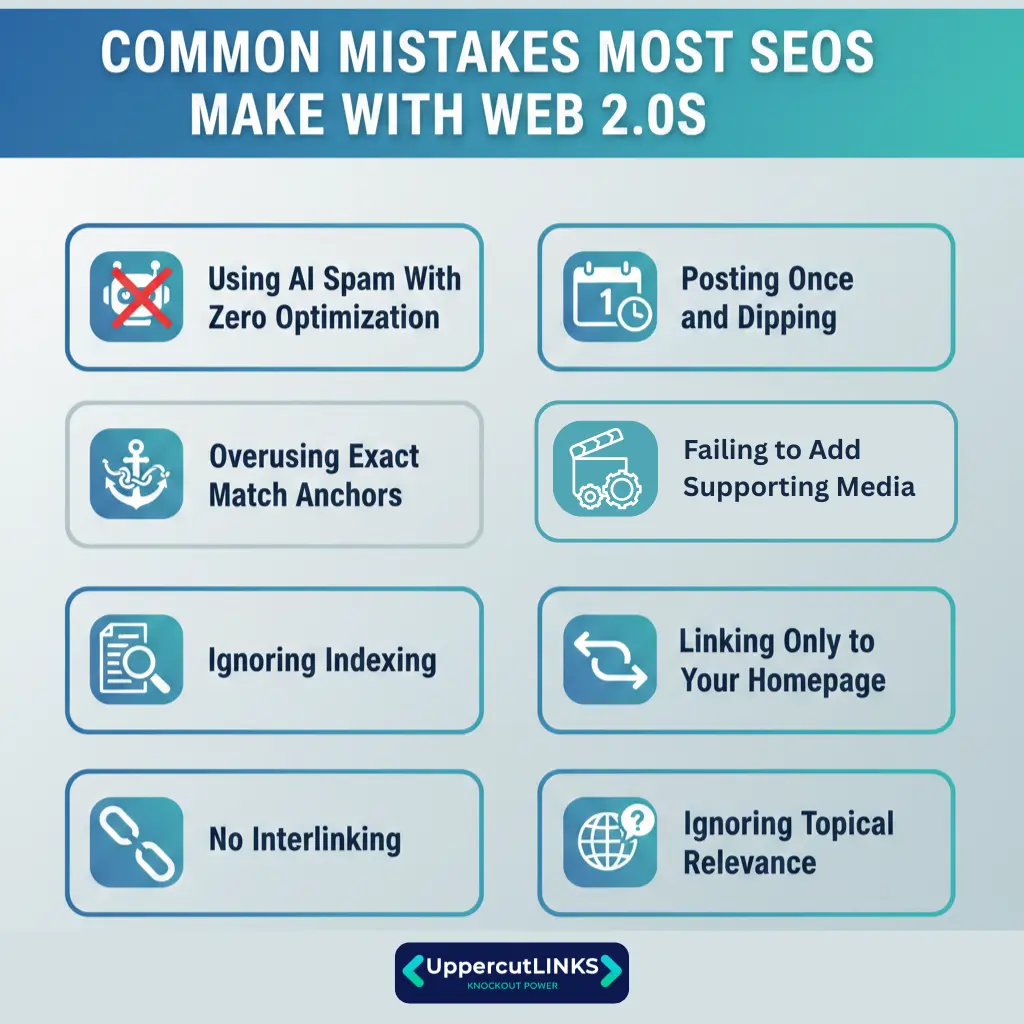
In 2026, AI is a powerful assistant, not a quality replacement. The biggest mistake is generating a 500-word article with an AI tool and publishing it without any edits. These articles often lack a real voice, have no unique insights, and are easily flagged by platforms and Google as “unhelpful content.”
How To Fix It: Use AI for brainstorming and outlines, but always rewrite the content in your own voice. Add your own examples, case studies, and a human touch.
This is the most dangerous mistake and the biggest red flag for Google. If you are trying to rank for “best coffee beans” and every single Web 2.0 backlink you build uses the anchor text “best coffee beans,” you are screaming, “I’m trying to manipulate the algorithm!”
How To Fix It: As we covered in the blueprint, diversify! Your anchor text profile should be mostly branded (“Your Brand Name”) and naked URLs (https://yourbrand.com), with only a small percentage of exact or partial match anchors.
You spend hours creating a fantastic article on Blogger, place your link perfectly, and hit publish. Then you forget about it. If Google never crawls and indexes that page, your backlink has an SEO value of zero. It doesn’t exist in Google’s eyes.
How To Fix It: Actively ensure your new posts get indexed. Share them on social media, use an indexing tool, or even link to your new post from another one of your Web 2.0 properties.
You create 10 different Web 2.0 properties on 10 different platforms, and none of them link to each other. They are isolated islands. This is a missed opportunity to create a powerful private network.
How To Fix It: In some of your posts, link from your Blogger article to your Tumblr article, and from your Tumblr to your Weebly site. This passes authority between your properties, makes them stronger, and creates a more natural-looking web of content.
Creating a profile, publishing one single article with a link, and then abandoning the account forever is a clear footprint. It signals to the platform and to Google that this property was created for the sole purpose of getting a link, making it look highly manipulative.
How To Fix It: Keep your best properties alive. Log in occasionally. Maybe add a new post once every few months. This makes them look like legitimate, active blogs, increasing the long-term value of your seo backlinks.
A massive red flag for an unnatural backlink profile is when 100% of your links point to your homepage. It tells Google that you are only trying to boost your domain authority, not that you’re linking naturally to relevant, useful content that lives deeper within your site.
How To Fix It: Implement a “deep linking” strategy. Make sure only 30-40% of your links point to your homepage. The majority should point to your important inner pages: service pages, product pages, and, most importantly, your high-quality blog posts and informational articles. This looks far more natural and boosts the authority of your entire website, not just the front page.
This is a subtle but powerful mistake. You create a beautifully written article on a Blogger.com site about “The 5 Best Breeds of Household Cats” and then drop a link to your website that sells “Cryptocurrency Trading Software.” The content of the article and the destination of the link have zero connection. Google’s algorithm is smart enough to see this disconnect and will devalue the link significantly.
How To Fix It: Always maintain a strong topical bridge between your Web 2.0 content and the page you are linking to. The Web 2.0 blog should be in the same general niche as your main site. The article itself should be directly related to the topic of the page you are linking to, making the click-through logical and helpful for a potential reader.
Yes, Web 2.0 backlinks are safe if you build them correctly. A poor strategy, however, carries two main risks:
The key to safety is to avoid leaving obvious “footprints.” Always vary your usernames, titles, content structure, anchor text, and the pages you link to. The more variety, the more natural and effective your campaign will be.
To help you decide if this strategy is right for you, here’s a quick summary of the pros and cons.
This is the most common question, and it’s the wrong one to ask. The focus should be on quality, not quantity. Building 5-10 high-quality, well-maintained Web 2.0 properties with unique, valuable content will have a far greater impact than creating 100 spammy, low-effort blogs. Start small, master the process, and scale slowly.
A direct manual penalty from Google for using Web 2.0s is highly unlikely if you follow the quality-first strategy in this guide. The more realistic risk from a poor, spammy strategy is that Google’s algorithm will simply ignore your links, meaning you wasted your time. To ensure your Web 2.0 backlinks are safe, always prioritize quality and diversity in your content and anchor text.
SEO is a marathon, not a sprint. After you publish a post, it first needs to be indexed by Google, which can take anywhere from a few days to a few weeks. You may start to see an impact on your rankings in as little as 4-6 weeks, but for competitive keywords, it can take several months for the full authority of these links to be realized.
No. While dofollow web 2.0 sites are essential for passing direct link equity, a natural backlink profile contains a mix of both DoFollow and NoFollow links. High-authority platforms like Medium or Quora can send significant referral traffic and build brand trust, which are powerful indirect SEO signals. A healthy strategy includes both.
Absolutely not. Publishing the same article across multiple platforms is a massive spam signal known as duplicate content. Each article you post should be 100% unique. This maximizes the value of each property and ensures you are creating a network of distinct assets, not a trail of easily detectable spam.
Yes. The platforms on this list have been curated for their long-term authority and stability. We’ve focused on major, established players like WordPress, Blogger, and Google Sites that have been cornerstones of the internet for over a decade. While smaller sites can come and go, this list represents the most reliable and powerful Web 2.0 platforms for SEO in 2026.
So, are Web 2.0 backlinks a magic bullet for SEO in 2026? No. Are they an outdated, useless tactic? Absolutely not.
The debate misses the point entirely. A Web 2.0 property is a tool, and like any tool, its effectiveness depends entirely on the person using it. In the hands of a low-effort spammer, it creates digital junk. But in the hands of a smart SEO, in your hands, it builds digital assets.
Stop thinking of your Blogger or Tumblr site as a place to quickly drop a link. Start thinking of it as a small digital embassy for your brand, a valuable outpost on a high-authority domain that represents your business, provides real value, and funnels authority and trust back to your main website.
The goal of this off-page seo technique is not to have 100 abandoned digital ghost towns. It’s to have 5-10 thriving digital embassies that actively support your SEO goals for years to come. You have the blueprint, you have the tools, and you have the safety manual. The authority is there for the taking.
Now build it the right way.